VISUAL MUSIC THEORY · CHORD ATLAS
All triads reduce to 4 shapes.
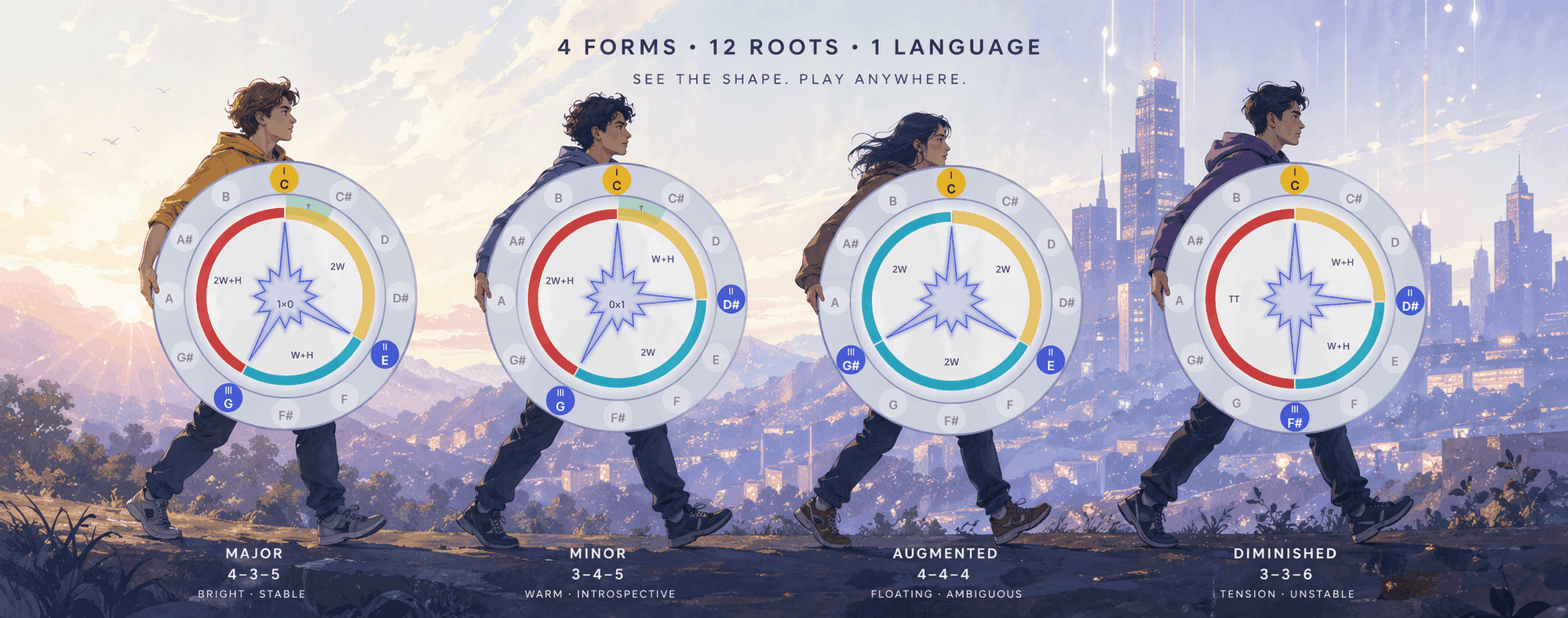
Stop memorizing chord names as separate facts. Major, Minor, Diminished, and Augmented are the four geometric interval identities behind all basic harmony.
THE TRIAD ATLAS
Major
Bright asymmetry
Minor
Mirror warmth
Diminished
Compressed tension
Augmented
Perfect symmetry
01 · THE INSIGHT
A chord type is a triangle you can rotate
Traditional theory teaches C Major, D Major, and G Major as different note lists.
But on the chromatic circle they are the same geometric object in different positions.
That is the core move of TerryTrilla:
- stop treating chords as note inventories
- start seeing them as interval structures
- then watch transposition become rotation
Think in interval DNA.
Names change when you rotate a chord. The interval pattern does not.
ROTATE THE SAME TRIANGLE
One type, many positions
A chord quality does not need 12 separate explanations. It needs one geometric identity you can recognize anywhere.
02 · THE SHAPES
The 4 fundamental chord shapes
Every basic triad is one of these four interval geometries. They differ by symmetry, tension, and the spacing between their three points.
Major · 4–3–5
Asymmetric, bright, and stable. This is the default “resolved” triangle of tonal harmony.
Interval identity: [0, 4, 7]
Minor · 3–4–5
The mirror of major: same stability class, different emotional gravity.
Interval identity: [0, 3, 7]
Diminished · 3–3–6
Compact and pressurized. It feels unstable because the shape squeezes tension into a tighter space.
Interval identity: [0, 3, 6]
Augmented · 4–4–4
Perfectly equilateral. It floats because symmetry weakens tonal direction.
Interval identity: [0, 4, 8]
03 · LIVE LAB
See one shape move
Build a triad on the circle, rotate it, and notice what changes: the root changes, the position changes, but the chord type stays the same.
- Build one triad.
- Rotate it around the circle.
- Notice the name change.
- Notice the shape stays the same.
Transposition is rotation.
That one idea collapses dozens of isolated chord facts into one visible pattern.
The symmetry spectrum
The four shapes form a structural spectrum from strong tonal identity to near-perfect ambiguity.
Major
Asymmetric · stable
Minor
Mirror · stable
Diminished
Partial symmetry
Augmented
Perfect symmetry
These four shapes also form a structural spectrum:
- Major [4–3–5] — asymmetric
- Minor [3–4–5] — asymmetric mirror
- Diminished [3–3–6] — partially symmetric
- Augmented [4–4–4] — perfectly symmetric
As symmetry rises, tonal certainty weakens. That is why augmented and diminished chords feel more unstable or ambiguous than major and minor.
04 · THE ANOMALY
Why augmented is different
The augmented triad divides the octave into three equal parts: 4 + 4 + 4.
That perfect symmetry means rotating the shape often lands you on the same note-set again.
So unlike the other three chord types, augmented triads produce only 4 distinct pitch collections, not 12.
C Augmented = E Augmented = G# Augmented
They are three names for the same equilateral triangle: {C, E, G#}.
12 roots collapse into 4 pitch collections.
All 4 shapes side by side
| Shape | Steps | Geometry | Sound | Distinct Sets |
|---|---|---|---|---|
| Major | 4 – 3 – 5 | Asymmetric triangle | Bright, stable | 12 |
| Minor | 3 – 4 – 5 | Mirror triangle | Warm, inward | 12 |
| Diminished | 3 – 3 – 6 | Compact cluster | Tense, unstable | 12 |
| Augmented | 4 – 4 – 4 | Perfect equilateral | Floating, ambiguous | 4 |
Pattern to remember: only augmented breaks the 12-root expectation because symmetry makes multiple roots equivalent.
Frequently asked questions
Are there really only 4 chord shapes?
For basic triads, yes. Major, Minor, Diminished, and Augmented exhaust the possible combinations of root, third, and fifth quality.
What about suspended chords, power chords, and sevenths?
They matter, but they either remove the third, add notes beyond the triad, or extend a triadic base. This article focuses on the four core triad geometries underneath them.
Why does geometry matter here?
Because geometry reveals what memory hides: sameness, symmetry, contrast, and movement. Once you see the shapes, harmony stops feeling like unrelated facts.
See the 4 shapes yourself
Open the Scale Circle, build a triad, and compare what you see. After a few rotations, you stop seeing isolated chords and start seeing a small visual alphabet of harmony.
4 shapes
12 roots
1 visual grammar
Explore each shape in detail
- The Major Shape
- The Minor Shape
- The Diminished Shape
- The Augmented Shape