Chord Theory Modules
Interactive demonstration of chord mathematics, recognition, and scale mapping algorithms
Scale Circle
Click notes to select, tap star for actions
Chord Matrix
7x7 matrix showing chords for each mode and degree in a scale family
Guitar Fretboard
Piano Keyboard
What Is Chord Theory?
Chord theory is the branch of music theory that studies how chords are built, how they function within keys, and how they relate to scales. Understanding chord theory gives musicians the ability to analyze any song, create compelling harmonies, build chord progressions from scratch, and improvise confidently. Rather than memorizing hundreds of chord shapes by rote, chord theory reveals the underlying logic: every chord is a specific combination of intervals stacked above a root note, and every chord belongs to one or more scales. This knowledge transforms how you hear, play, and compose music across any genre and instrument.
Interactive Chord Theory Tools
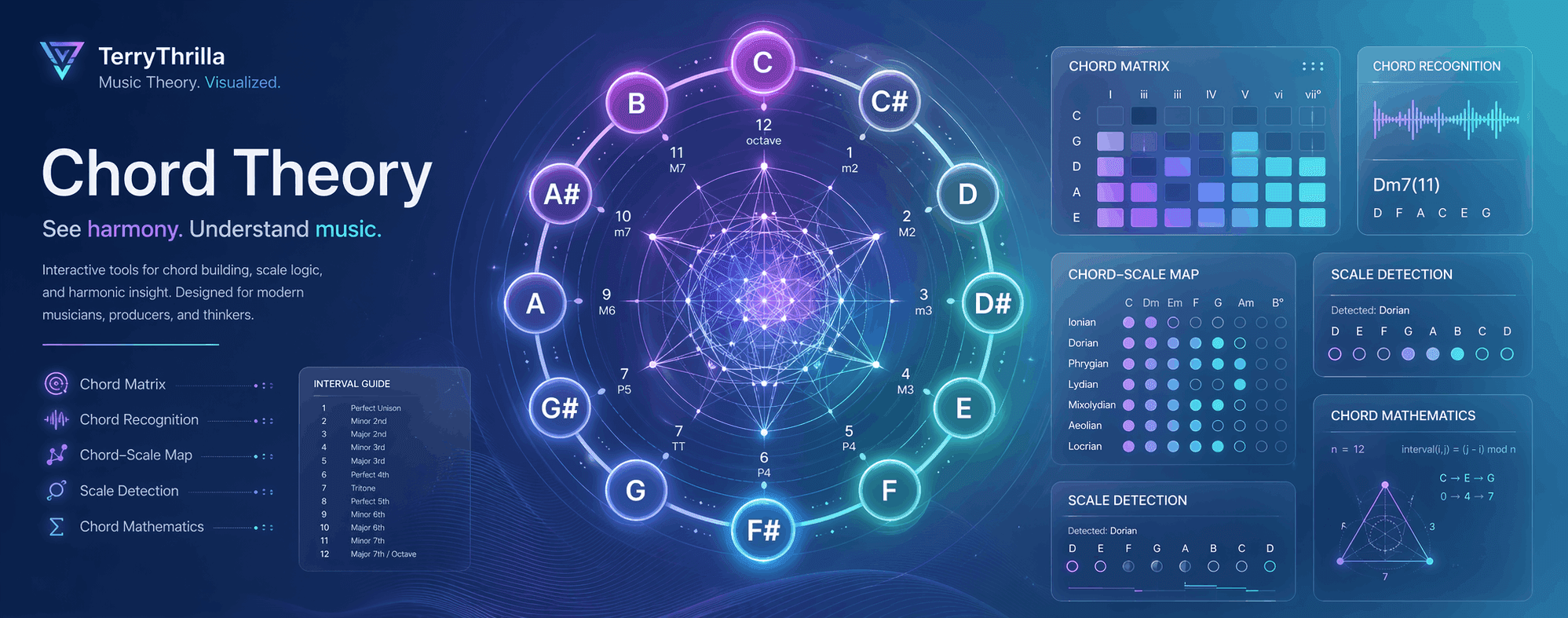
TerryTrilla offers five specialized tools that work together through a synchronized TerryTrilla Circle. Select notes on the circle, and every tool updates in real time:
Chord Matrix
A comprehensive 7x7 grid showing all diatonic chords for each mode and degree within a scale family. Explore how the same set of notes generates different chords depending on the mode. Click any chord to hear it and see it highlighted on the TerryTrilla Circle and guitar fretboard — an essential tool for understanding diatonic harmony and modal interchange.
Chord Math Calculator
Convert between interval notation, step patterns, and canonical chord forms. Enter any set of intervals to see all possible rotations, identify the chord type, and understand its internal mathematical structure. This tool bridges the gap between abstract music theory and practical chord construction.
Chord Recognition
Select any combination of notes and instantly identify the chord they form. The tool shows the chord name, symbol, root note, bass note, inversion type, and all alternative interpretations ranked by priority. Perfect for analyzing chords you hear in songs or discover on your instrument.
Scale-Chord Mapper
Choose any chord and discover which scales contain it. This tool reveals the chord-scale relationships that jazz musicians, composers, and arrangers rely on daily. See which degree each chord occupies in every matching scale — invaluable for choosing the right scale for improvisation over any chord.
Scale Detection
Select a group of notes and identify which scales they belong to. The tool ranks matches by confidence level, showing exact and partial matches. Use it to analyze melodies, find the key of a song, or discover new scales that fit the notes you are already playing.
TerryTrilla Circle Controller
The interactive TerryTrilla Circle serves as the central hub connecting all five tools. Click notes to select them, view the current tonic, active notes, detected scale, and chord. Every selection instantly propagates to the Chord Matrix, Calculator, Recognition, Mapper, and Detection modules, creating a seamless analytical workflow.
How to Use These Tools for Learning
Start by selecting a key on the TerryTrilla Circle, then explore the Chord Matrix to see all available diatonic chords. Pick a chord that interests you and switch to the Scale-Chord Mapper to discover which scales work with it. Use Scale Detection to analyze melodies from songs you are learning, and Chord Recognition to identify chords you play by ear. The Chord Math Calculator helps you understand why chords sound the way they do by revealing their intervallic DNA. Together, these tools create a complete chord theory laboratory where every concept connects to every other.
Master Chord Theory on TerryTrilla
Our integrated chord theory suite combines five powerful analytical tools with real-time visualization on the TerryTrilla Circle and guitar fretboard. Every tool is synchronized — change a note anywhere and see the results everywhere. Whether you are a songwriter searching for the perfect chord progression, a jazz musician mapping scales to changes, or a music student building a solid theoretical foundation, these interactive modules turn abstract theory into hands-on understanding. No textbook can match the insight you gain from experimenting with chords and scales in real time.