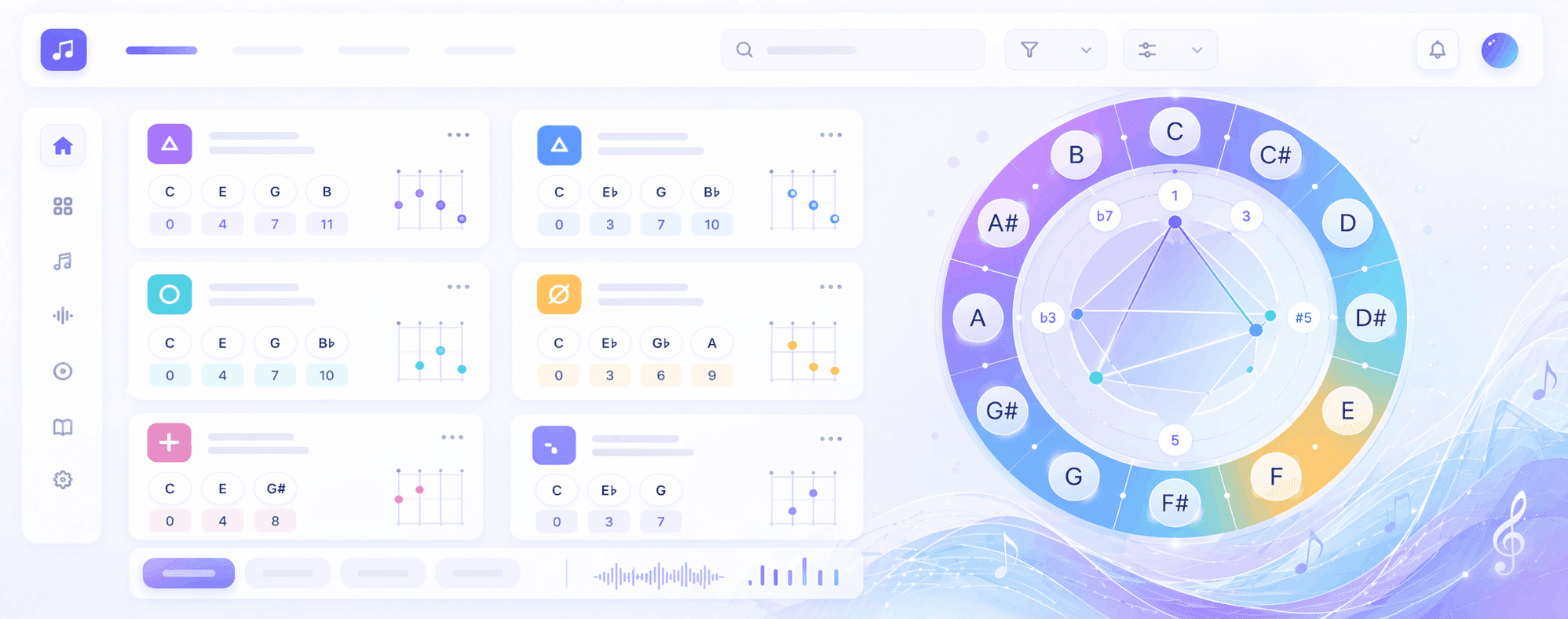
Guitar chords and piano chords
Explore our comprehensive collection of 74 chords. From basic triads to complex jazz voicings.
Triads4
Seventh Chords12
Major 7th
Cmaj74 notes
Major + major 7th
Minor 7th
Cm74 notes
Minor + minor 7th
Dominant 7th
C74 notes
Major + minor 7th
Half-Diminished 7th
Cm7b54 notes
Diminished triad + minor 7th
Diminished 7th
Cdim74 notes
Diminished triad + diminished 7th
Minor Major 7th
CmMaj74 notes
Minor + major 7th
Augmented Major 7th
CaugMaj74 notes
Augmented triad + major 7th
Augmented 7th
Caug74 notes
Augmented triad + minor 7th
Major 7th b5
Cmaj7b54 notes
Major + diminished 5th + major 7th (Lydian flavour)
Minor 7th #5
Cm7#54 notes
Minor + augmented 5th + minor 7th
Diminished Major 7th
CdimMaj74 notes
Diminished triad + major 7th
Dominant 7th (no 5th)
C7no53 notes
Root + major 3rd + minor 7th (shell voicing, omit 5th)
Extended Chords8
Major 9th
Cmaj95 notes
Major7 + major 9th
Minor 9th
Cm95 notes
Minor7 + major 9th
Dominant 9th
C95 notes
Dom7 + major 9th
Minor 9th b5
Cm9b55 notes
Half-diminished + major 9th
Major 9th #11
Cmaj9#116 notes
Major9 + augmented 11th (Lydian)
Dominant 9th #11
C9#116 notes
Dom9 + augmented 11th (Lydian dominant)
Dominant 9th b5
C9b55 notes
Dom7b5 + major 9th
Dominant 9th #5
C9#55 notes
Dom7#5 + major 9th
A chord is three or more notes sounding at once, and this page is where you go to find the one you need — guitar chords and piano chords for the same seventy-four names, side by side. Seventy-four chords are described here in full: the notes they are built from, how they are fingered on guitar and laid out on a keyboard, and the situations in which each one is the right answer. They are sorted into eight groups rather than into one long alphabetical list, because almost nobody arrives knowing the exact name — people arrive knowing the sound, the shape of the grip, or the notes they are staring at.
Three ways to arrive at a chord
Anyone looking for a chord arrives by one of only three routes, and it is worth knowing which one you are in. The first is by name: you have a chart in front of you that says Bm7, and you need to know where to put your fingers. The second is the reverse — you have the notes, from a score or from keys you are holding down, and you need the name. The third is by ear: a song is playing and you want the sequence behind it.
The first two are lookups and this catalogue answers them directly. The third is a different kind of problem, because a recording does not hand you separate notes; it hands you a wall of sound with the chord buried in it. That one is answered further down the page.
Knowing which of the three you are in saves time. Searching by name when you actually have notes in front of you means guessing at spellings until one of them lands, and the same set of notes can carry several different names.
How to read a chord chart
A guitar chord chart is a picture of the fretboard seen head-on, with the headstock at the top. The six vertical lines are strings, low E on the left; the horizontal lines are frets. A dot on a line means press that string at that fret. Above the diagram, an O marks a string played open and an X marks one that is not played at all — the X is the mark most often ignored by beginners, and ignoring it is what makes a clean grip sound muddy. Numbers inside the dots, when present, are fingers: 1 is the index, 4 the little finger.
A piano chord chart is a drawing of a stretch of keyboard with the keys to press marked. It carries less information than the guitar version because a piano has one key per pitch, while a guitar has the same pitch in several places, and choosing between them is half the craft of playing.
The two charts answer different questions, which is why this catalogue shows both for every chord: guitar chords as grips, piano chords as notes. The guitar chart tells you a grip. The piano chart tells you the notes. A guitarist who only ever reads grips can play hundreds of songs and still not know what is inside the chord — and the moment a chart calls for something without a stock shape, there is nothing to fall back on.
Which guitar chords to learn first
The question behind most first visits is not what a chord is but which guitar chords are worth the first week. The working answer is six: E minor, A minor, D major, G major, C major and E major. Between them they cover a large share of songs in the keys guitarists actually play, and every one of them is fingered inside the first three frets with nothing barred.
F major is the wall, and it is worth knowing why rather than treating it as a test of willpower. It has no open-string shape, so the standard fingering lays one finger flat across all six strings while the other three build a chord on top of it. Most people who stop learning guitar stop here. The way through is not more grip strength but the three-string version — the top half of the shape, which is harmonically complete enough to carry a song while the hand catches up over the following weeks.
The starting set for piano chords is different, because a keyboard asks nothing of grip strength and has no barre: C, F and G major are learned in an afternoon, since each is three white keys with the same spacing. The difficulty arrives later and elsewhere — at the point where the left hand has to hold time and voicing while the right hand plays a melody.
Finding a chord from its notes
The reverse lookup — notes in, name out — has one property that surprises people: the answer is not unique. C, E, G and A together are a C major sixth. They are also an A minor seventh. Nothing in the four notes decides between the two names; what decides is which note the bass is playing and where the chord is going next.
This is not a flaw in the naming system. A chord name is a claim about function, not just about pitch content, and two claims can be made about the same handful of notes. Software that answers such a question with a single name and no alternatives is hiding the interesting part.
The practical rule: identify the lowest note first, then read the rest as distances above it. If that reading produces a name you recognise, you are probably right. If it produces something exotic, try treating a different note as the root and see whether the shape becomes ordinary.
Eight groups and what separates them
The groups below are not arbitrary shelving. Each one is defined by a structural fact — how many notes the chord has, what intervals stack up inside it, or which note has been replaced by another.
Triads are the three-note foundation and there are exactly four of them. Seventh chords add one more note and are the working vocabulary of jazz, soul and most film music. Extended chords keep stacking past the seventh into ninths, elevenths and thirteenths. Suspended chords remove the third — the note that makes a chord major or minor — and put a neighbour in its place, which is why they sound unresolved. Add chords bring in an extra note without the stack underneath it. Altered chords sharpen or flatten a note deliberately to create tension. Power chords drop to two notes and gain volume by losing the third. Quartal chords abandon stacked thirds altogether and build from fourths.
The comparison table below gives the size of each group and its defining trait, and each name leads to a page covering that group in depth.
Chords inside a recording
Pulling chords out of audio is the third question, and it is much harder than either lookup, because the information you need has been mixed together. A guitar strum, a bass note and a vocal all arrive as one signal, and the chord has to be reconstructed from the overtones of everything at once.
Doing it by ear is a genuine skill and a slow one to build. The usual shortcut — searching for a chord sheet someone else typed out — works for famous songs and fails for everything else, and the sheets that do exist are often wrong in exactly the places that matter, because whoever wrote them simplified a chord they could not name.
This is where the studio side of the site does something the catalogue cannot. You give it audio or a MIDI file, and it separates the notes, works out the harmony behind them, and writes the chords over the score — including the ones nobody would think to look up.
Playing chords and melody together
A common next question, on both instruments, is how to hold a melody and its chords at the same time. On piano the standard division is chords in the left hand and melody in the right, and the difficulty is that the left hand must stay quiet enough not to bury the tune.
On guitar the same idea is called chord melody, and it is harder, because both jobs land on one set of six strings. The usual method is to put the melody note on a high string, keep only the essential notes of the chord underneath it, and let the rest go. This is where the groups above start to matter: knowing that a seventh chord survives losing its fifth, but not its third or seventh, is what lets you thin a grip down to something playable.
Frequently asked questions
How many chords do I actually need to know?
For accompanying songs, far fewer than the size of this catalogue suggests. A large share of popular music sits on major and minor triads plus dominant sevenths, in two or three keys. The rest of the catalogue exists for the moment you meet a chord outside that set and need to know what it is rather than skipping it.
Why does the same shape have more than one name?
Because a name describes a chord's role, not only its notes. The same four notes can be a sixth chord in one context and a minor seventh in another, and which one is correct depends on the bass note and on where the music goes next. Each chord page lists the names its notes can also carry.
Should I learn chords on guitar or on piano first?
Piano makes the structure visible — the distances between notes are laid out in front of you and every chord is built the same way. Guitar makes the sound available faster, since a handful of grips covers a lot of songs. If the goal is understanding harmony, the keyboard is the shorter road; if the goal is playing songs this month, the guitar is.
What does the X above a guitar chart mean?
That the string is not played. It is either muted with a spare finger or avoided by the strumming hand. Letting it ring is the single most common reason a correctly fingered chord still sounds wrong, because the extra note is often a step away from one already in the chord.
The eight groups at a glance
| Group | Chords | What holds it together |
|---|---|---|
| Triads | 4 | Three notes in thirds. Every other chord in the catalogue is one of these four with something added, removed or altered. |
| Seventh Chords | 12 | A triad plus a seventh. Only one of them contains a tritone, and only that one has to resolve. |
| Extended Chords | 19 | The stack of thirds carried past the seventh. The skill is choosing what to leave out, not what to add. |
| Suspended Chords | 10 | The third replaced by a second or a fourth, so the chord never says whether it is major or minor. |
| Add Chords | 11 | A note added to a triad without a seventh. Colour with no obligation to move on. |
| Altered Chords | 10 | A dominant with its fifth or ninth deliberately raised or lowered. Third and seventh stay untouched. |
| Power Chords | 3 | Two notes, root and fifth. No third, and that is exactly why it survives distortion. |
| Quartal Chords | 5 | Built from fourths or fifths instead of thirds, so no note claims to be the root. |
What Are Musical Chords?
A chord is a group of notes sounded together to create harmony. Chords are the building blocks of harmonic structure in music — they accompany melodies, define the mood of a song, and drive musical movement through chord progressions. Learning chords is essential for guitarists, pianists, songwriters, and anyone who wants to understand how music works. Chords are built by stacking intervals on top of a root note. The specific combination of intervals determines the chord's quality and color: a major chord sounds bright and stable, a minor chord feels darker and more emotional, and a dominant seventh chord creates tension that naturally wants to resolve.
Types of Musical Chords
Chords are categorized by their structure and the number of notes they contain. Here are the main families of chords in our library:
Triads
The simplest and most fundamental chords, consisting of three notes: a root, a third, and a fifth. The four basic triad types — major, minor, diminished, and augmented — form the foundation of all chord harmony. Open major and minor triads on guitar are typically the first chords every musician learns.
Seventh Chords
Adding a fourth note — the seventh — to a triad creates a richer, more colorful sound. Major seventh chords (maj7) have a warm, sophisticated quality. Dominant seventh chords (7) create tension and drive. Minor seventh chords (m7) are smooth and versatile. Diminished and half-diminished sevenths add dark, mysterious harmonic colors.
Extended Chords
These chords build further by adding ninths, elevenths, and thirteenths above the seventh. Extended chords are essential in jazz, R&B, neo-soul, and modern pop music. A Cmaj9 or Dm11 can transform a simple progression into something sophisticated, lush, and harmonically interesting.
Altered Chords
Altered chords modify the fifth or ninth of a dominant chord (sharp 5, flat 5, sharp 9, flat 9), creating intense chromatic tension that resolves dramatically. Jazz musicians use altered dominant chords extensively for expressive harmonic movement over ii-V-I progressions.
Suspended Chords
Suspended chords (sus2, sus4) replace the third with a second or fourth, creating an open, ambiguous sound that is neither major nor minor. They are common in rock, pop, and ambient music, often used to add movement and anticipation between other chords in a progression.
Power Chords
Consisting of just a root and fifth with no third, power chords are neither major nor minor. They are the backbone of rock, punk, and metal guitar playing, delivering a heavy, direct sound that cuts through distortion and high-gain amplifier settings.
How to Learn Chords Effectively
Start with the most common open chords on guitar — C, G, D, E, A, Am, Em, Dm — or basic triads in all inversions on piano. Master smooth transitions between chords before adding complexity. Learn chord families within keys to understand which chords naturally belong together. Study different voicings: the same chord can be played in many positions across the fretboard or keyboard, and each voicing gives the chord a different texture. Most importantly, practice with real songs — apply your chord knowledge to music you love and analyze the progressions in your favorite tracks.
Explore Chords on TerryTrilla
Our interactive chord library provides visual diagrams for guitar and piano for every chord type. See how each chord is constructed from intervals, listen to its sound with built-in audio playback, and discover related voicings and chord variations. Use the interactive fretboard and keyboard to explore chord shapes across all positions and keys. Whether you are a beginner learning your first open chords or an advanced musician studying jazz voicings, TerryTrilla helps you master chords visually, audibly, and theoretically.