TERRYTRILLA · SMART METRONOME
Online Metronome
A free online metronome that goes beyond 4/4 — 13 flamenco palos, polyrhythm in three layers, odd meters and three training modes.
Rhythm is a closed loop
Most online metronomes do one thing: count beats. That is useful. But if you play Bulería, study Balkan rhythms or work on 3-against-4 polyrhythm, the standard tick-tock leaves you on your own.
The TerryTrilla Smart Metronome works differently. Rhythm here is not a straight line running off to the right. A bar does not end on its last beat — it flows into the first beat of the next cycle. That is exactly how musicians who work with cyclic structures think: the flamenco compás, the Indian tala, the Cuban clave.
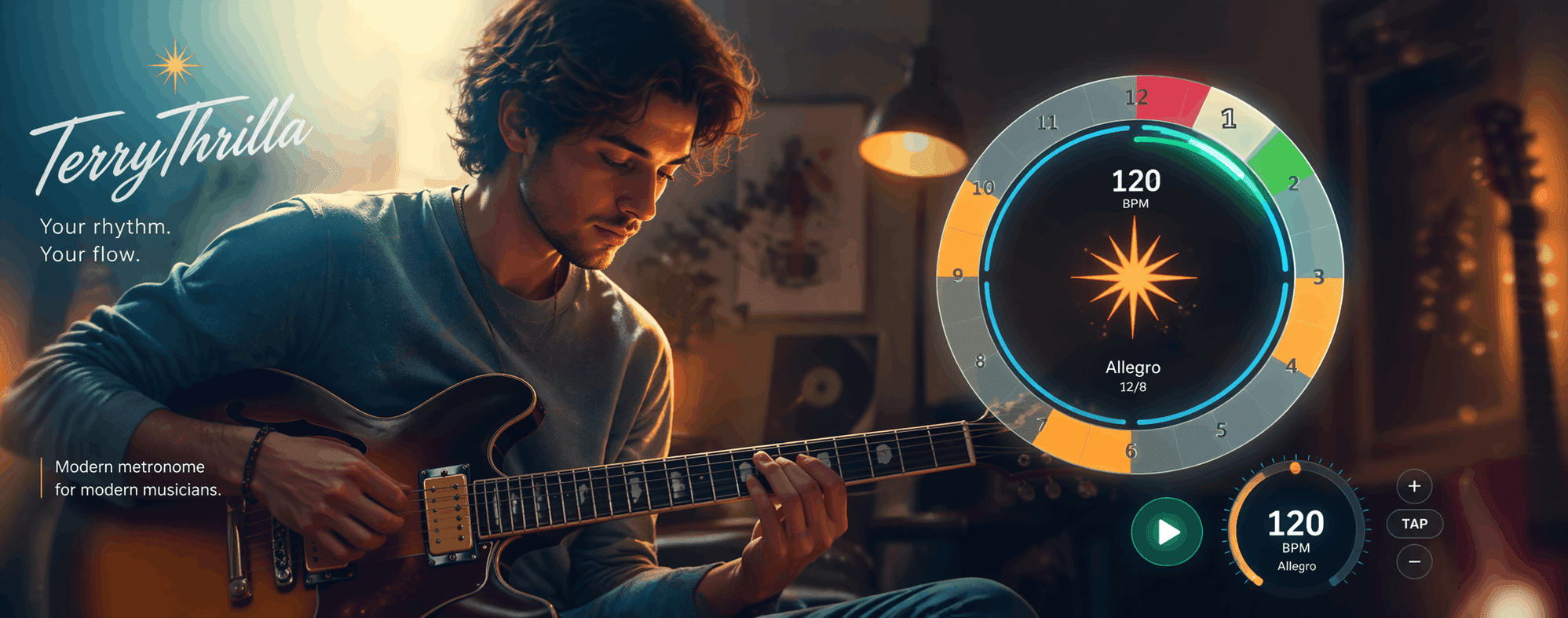
How the beat wheel works in this online metronome
A circle divided into N equal sectors — one per beat. Inside it several layers of information work at once, so a glance is enough to see where the bar is going.
Outer ring of sectors
Every beat is a sector. Colour and brightness show how strong the accent is. Subdivisions — eighths, triplets, sixteenths, quintuplets, sextuplets — fill the sector from inside. These are real audible clicks, not decoration.
Three arc rings
Groupings (2+2+3 in 7/8), phrase structure — call-and-response, clave 3–2, <em>fuerte</em> and <em>suave</em> in Soleá — and an animated progress arc that sweeps around the cycle in real time.
Pulse star at the center
Points are beats, point length is accent strength. On every strike the current point grows by 20% and fades back in about 200 ms. Bulería and Soleá make two different stars, though both run 12 beats.
UNIQUE ARCHITECTURE
Clock Mode and Wheel Mode — two modes of one circle
Clock Mode — familiar meters
For 4/4, 3/4, 6/8 and 12/8 the circle keeps twelve reference points, like a clock face. A familiar structure — but alive and moving.
Wheel Mode — non-standard meters
For 5/4, 7/8, 9/8, 11/8 and the 16-beat Tintal the twelve markers disappear and the circle rebuilds itself into N equal sectors. The switch happens by itself.
An architectural decision we have not found in any competing metronome.
Flamenco — 13 palos with built-in compases
Each preset is more than a tempo. It is a correct compás with the right accents, groupings and phrase structure. Bulería 12 puts strong accents on beats 12, 3, 6, 8 and 10 — exactly where they belong. Soleá splits into fuerte and suave. Siguiriya keeps its characteristic asymmetry.
Alegría · Abandolaos · Bulería (6) · Bulería (12) · Bulería (variant) · Fandangos · Rumba · Sevillanas · Siguiriya · Soleá · Tanguillos · Tangos · Tientos
Polyrhythm — for those who have outgrown 4/4
Up to three independent rhythmic layers at once — each with its own tempo ratio, timbre and volume, all locked to a mathematically correct master cycle. The cycles always close together, so drift is impossible.
Layer 1 — primary
Green. The reference pulse that every other layer locks to.
Layer 2 — secondary
Blue. Own beat count, own sound, own volume. Mute and solo independently.
Layer 3 — tertiary
Purple. Presets 2:3, 3:4, 4:3, 5:4, 3:2 and 4:5 — one click away.
Training modes — the metronome as a practice tool
Speed Trainer
Gradual BPM acceleration from a starting value to a target, in steps you set. A typical run: start at 60 BPM, add 5 every 45 seconds, stop at 144.
Bar Breaks
Silence every N bars. Four bars on, four off, then back again. Hold the tempo through the silence and come back exactly on the beat — the classic exercise for building an internal clock.
Random Drops
Random beats are dropped at a probability you set. At 30% you cannot lean on every click any more — you start hearing and feeling the rhythm instead of following it mechanically.
Professional-grade sound
60 FPS
Visualization runs on requestAnimationFrame. No lag against the audio even when the browser is loaded.
Microseconds
Web Audio API scheduling with look-ahead precision. Real professional accuracy.
9 sample categories
Classic click, drum kit, woodblock, palmas, cajón, darbuka, tabla, clave, electronic — plus synth clicks with zero latency.
Swing 0–75%
From a straight feel through a triplet feel to a hard shuffle. Applied to pairs, quadruplets and sextuplets.
The metronome inside the TerryTrilla Circle
The Smart Metronome is not a standalone application. It lives as one of the central modes of the Scale Circle — the same circular system where you explore scales, intervals, chords and instrument tuning.
The visual language is one and the same: the scale star and the pulse star follow the same principle — N points, and point length means intensity. The vocabulary does not change from mode to mode, so you are not learning a new interface, you are applying familiar logic to a new task.
Tuner, crystal, star and metronome — four central modes of equal weight inside a single widget. Learning music is not scattered across separate apps; it happens in one place.
Who this online metronome is for
Flamenco guitarist
Picks the Bulería preset and gets a correct 12-beat compás with palmas clara. The star shows the structure at a glance — no counting out loud.
Jazz drummer
Turns on 3-against-4, gives each layer its own timbre, then mutes the primary one — to check whether the three-beat figure holds without the main pulse.
Conservatory student
Sets 7/8 grouped 2+2+3, sees three grouping arcs and seven star points, hears the accent on beat five. Then switches to 2+3+2 and compares — by ear.
Music teacher
Switches on Tintal (16 beats) for a lesson on Indian tala. Wheel Mode opens the circle into sixteen sectors; the preset exports as JSON and goes to the student.
Hobby guitarist
Sets 4/4, turns on the speed trainer and works from 80 up to 120 BPM. The metronome does not tick — it pulses. That alone feels different.
Composer
Writes a contemporary piece in 11/8 (3+3+3+2) and saves the preset as JSON for the percussionist. Adds a 5:4 polyrhythm to test how the section holds it.
Metronome specifications
| Parameter | Value |
|---|---|
| BPM range | 20–300 |
| Subdivisions | eighths, triplets, sixteenths, quintuplets, sextuplets |
| Swing | 0–75% |
| Time signatures | 4/4, 3/4, 6/8, 2/4, 5/4, 5/8, 7/8, 9/8, 11/8, 12/8, 16 and more |
| Flamenco presets | 13 palos |
| Polyrhythmic layers | up to 3 |
| Sound timbres | 9 sample categories + synthesized clicks |
| Visualization | 60 FPS via requestAnimationFrame |
| Audio precision | microseconds (Web Audio API) |
| Training modes | Speed Trainer, Bar Breaks, Random Drops |
| Keyboard shortcuts | Space (play/stop), T (tap tempo) |
| Mobile support | yes, touch controls |
| Themes | light and dark |
| Test coverage | 591 tests, 97% code coverage |
Online metronome — frequently asked questions
READY TO PRACTICE
Study scales. Practise in tempo. One place for both.
Smart Metronome is part of the Terry Trilla platform — explore scales, chords and intervals in Scale Circle and practice them immediately at the right tempo.