ORIGINAL MUSIC FROM THE TERRY TRILLA PLATFORM
Music by Terry Trilla
Original music written on the Terry Trilla platform — every track on this page was composed using the same Scale Circle, notation editor and chord tools available to every user. What you hear is what music theory sounds like when you can see its geometry.
TerryTrilla
A playful educational song about TerryTrilla, teaching listeners to hear intervals, especially the third and the tritone, through melody, repetition, and vocal exploration.
Featured Compositions
Each track below links back to the exact platform state that produced it. Open it in the Scale Circle and you can transpose, reharmonise, change the mode or swap the chord progression — and hear the result instantly.
Four Winds
A composition exploring four modes of the harmonic minor scale, revealing shifting tonal colors and modal tension within a unified musical structure.
Room of Separation and Reliability
A harmonic minor study across different keys, exploring how its modal colors intersect with major diatonic harmony.
What Makes Terry Trilla Music Different
Most music libraries are organised by mood, BPM, or genre. The catalogue of compositions by Terry Trilla is organised by musical structure — because the platform itself treats structure as the primary object. A piece tagged Phrygian Dominant in D tells you something a “dark cinematic” tag never could: it tells you exactly which intervals are creating the tension and which scale degree the melody resolves to.
This makes the page useful in three different ways:
- For listeners — a curated stream of original tracks across genres, all produced on a single platform, all annotated with the theory that shapes them.
- For students of music theory — every composition is a worked example. You can hear what the Lydian #2 mode actually sounds like in melodic context, not just read its interval formula on a page.
- For composers and producers — the page works as a reference library of modal writing, exotic-scale composition and non-standard chord progressions, with the underlying scale geometry one click away.
How the Music Was Made
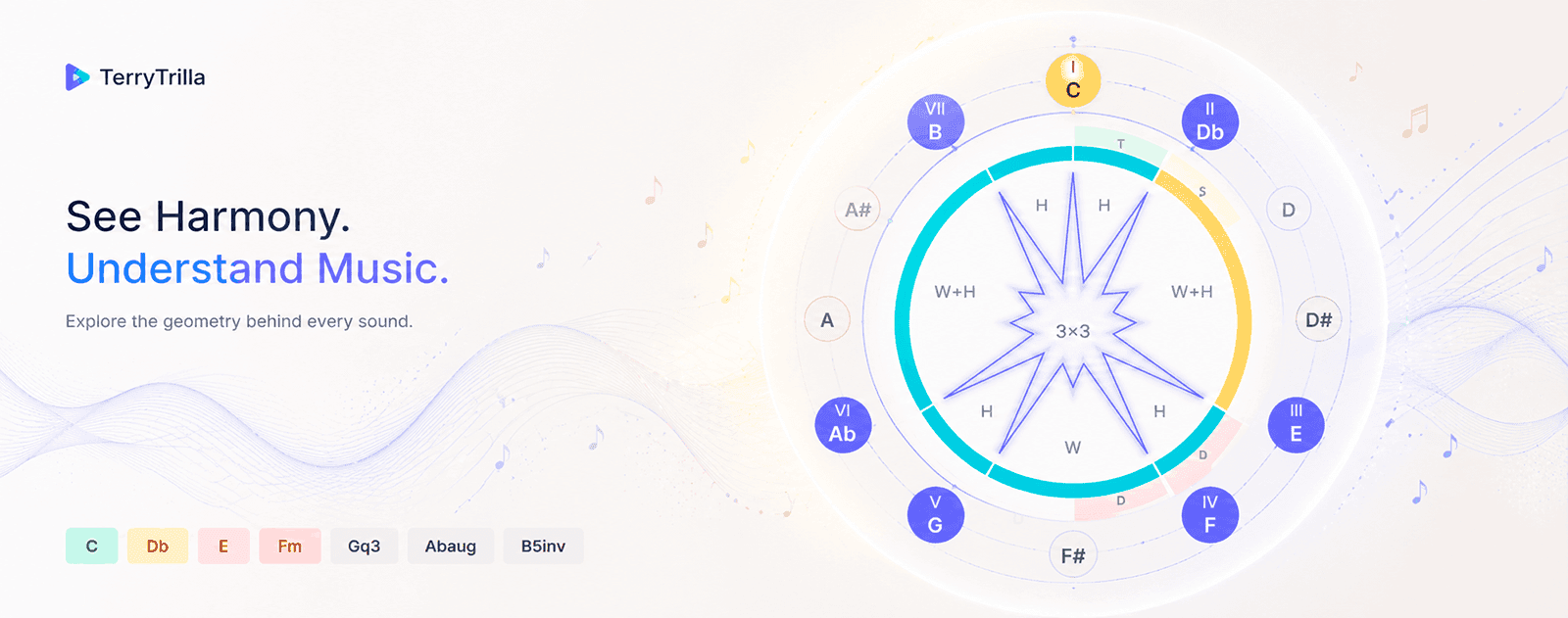
Compositions on this page were written using the platform’s three-layer workflow. The Scale Circle sets the tonal system: the author rotates the chromatic ring to a key, picks a scale family and the visual star pattern of the active notes appears. The notation editor receives that scale automatically — every note entered is checked against the active mode, and the consonance-dissonance arcs of the Scale Circle update in real time as the line develops. The chord track sits below the melody and resolves harmony beat by beat, with chord duration calculated from the spacing between filled slots.
Authors writing original music for Terry Trilla can move between scale families without rewriting their pieces — transposition is a rotation of the circle, modal substitution is a reassignment of the tonic, and the notation transposes with them. The result is a body of work that explores tonal territory most production tooling makes hard to reach: the music ranges from straightforward major-key writing to compositions in modes from the Hungarian, Byzantine, Japanese and Indian families that the platform’s scale database covers natively.
Music in Exotic Scales — A Listening Guide
Most music a Western listener encounters lives inside seven scale families: major, three minors (natural, harmonic, melodic) and the major and minor pentatonics. The Terry Trilla scale database covers 211 families. The compositions in this collection that use scales outside the common seven are tagged accordingly — Double Harmonic, Hungarian Minor, Neapolitan Major, Persian, Hirajōshi, Enigmatic, Bebop families and many more. Each tag is a starting point for listeners who want to hear what these tonal systems sound like in actual musical context, not isolated as scale exercises.
Modal Music Examples on Terry Trilla
The seven diatonic modes — Ionian, Dorian, Phrygian, Lydian, Mixolydian, Aeolian, Locrian — are the most commonly studied set, but they are one family among many. The catalogue includes modal writing across all of them, plus modes drawn from harmonic minor (Phrygian Dominant, Lydian #2), melodic minor (Lydian Dominant, Altered) and pentatonic families. For each modal track, the platform shows which mode is active, where the tonic sits and how the characteristic intervals of that mode shape the melody.
Theory-Annotated Music for Students and Educators
Music teachers and self-taught students often face the same problem: textbooks describe a concept, but finding a clear musical example of that concept in a real composition takes hours of searching. The Music by Terry Trilla page is structured as a queryable example library. Filter by scale family, mode, time signature or harmonic device, and the catalogue returns compositions that demonstrate exactly that feature — with the theory visible alongside the audio.
Discover the Music Theory Behind Every Track
The music on this page is not a closed gallery — it is the entry point to a working environment where you can become an author yourself. Pick a track, open it in the Scale Circle and start changing things.