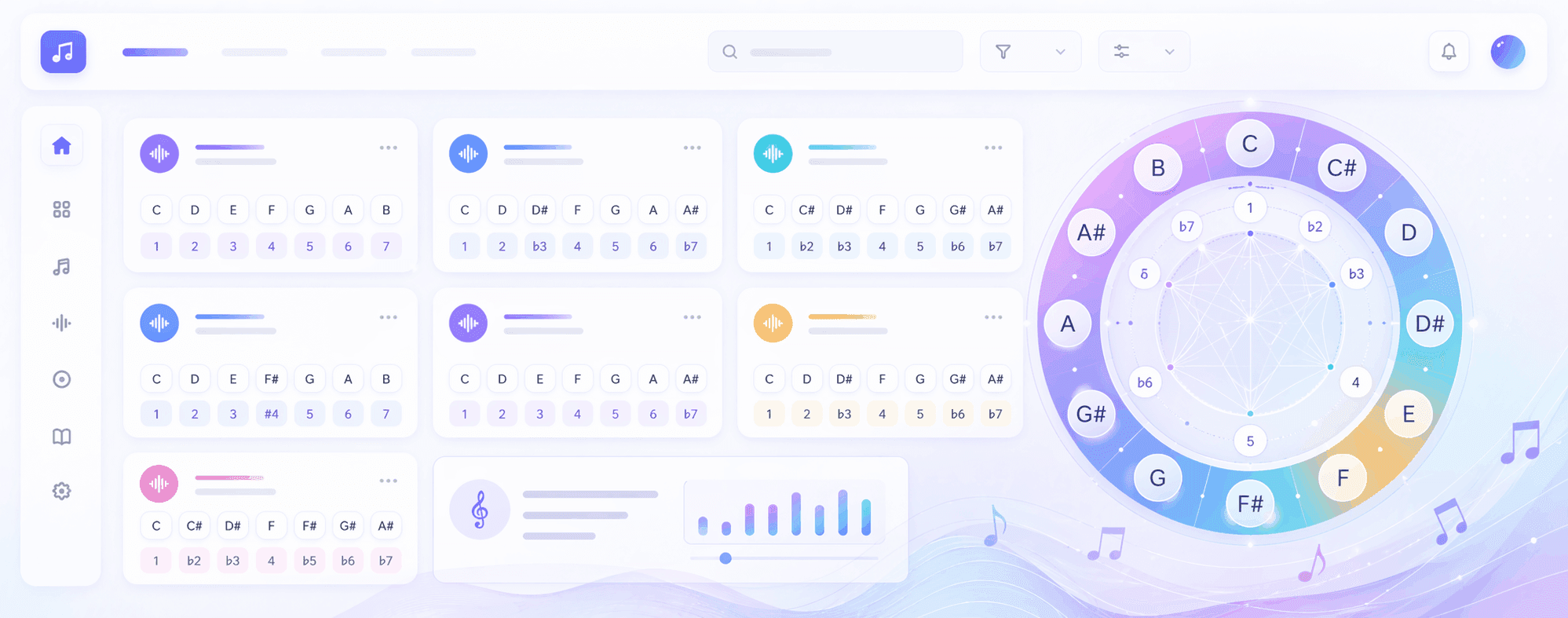
Music scales for guitar and piano
Explore our comprehensive collection of 1578 musical scales. From diatonic modes to exotic scales from around the world.
Diatonic7
Ionian (Major)
7 notes(also known as Major, C Major)
Dorian
7 notes
Phrygian
7 notes
Lydian
7 notes
Mixolydian
7 notes
Aeolian (Natural Minor)
7 notes(also known as Minor, Natural Minor)
Locrian
7 notes
Melodic Minor7
Melodic Minor
7 notes(also known as Jazz Minor)
Dorian b2
7 notes(also known as Phrygian #6)
Lydian Augmented
7 notes
Lydian Dominant
7 notes(also known as Lydian b7, Overtone)
Mixolydian b6
7 notes(also known as Melodic Major)
Locrian nat2
7 notes(also known as Half-Diminished)
Altered Scale
7 notes(also known as Super Locrian, Diminished Whole-Tone)
Harmonic Minor7
Harmonic Minor
7 notes
Locrian nat6
7 notes
Ionian #5
7 notes(also known as Ionian Augmented)
Dorian #4
7 notes(also known as Romanian Minor)
Phrygian Dominant
7 notes(also known as Spanish, Jewish)
Lydian #2
7 notes
Altered Diminished
7 notes(also known as Super Locrian bb7)
A scale is an ordered set of notes inside an octave, defined by the distances between them rather than by the notes themselves. Play the same pattern of steps from a different starting note and you have the same scale in another key. This catalogue holds 72 named music scales grouped into twelve families, each with its notes, its guitar scales and piano scales side by side as fingerings, and the chords it produces.
A scale is a pattern of distances, not a list of notes
C major and D major share only some notes, yet every musician hears them as the same scale. The reason is that a scale is defined by its interval pattern: for the major scale, tone-tone-semitone-tone-tone-tone-semitone. Move that pattern to any starting note and the character survives the move intact, which is why one shape learned on a guitar covers all twelve keys.
This is also why the note names matter less than beginners expect. Whether a scale is written with sharps or flats is a question of notation, decided by the key it sits in; the sound is identical either way. What changes the sound is the arrangement of tones and semitones, and every scale in this catalogue is catalogued by exactly that.
Where to start if you are choosing one
Two scales cover most playing. The major scale is the reference every other one is described against, and the minor pentatonic scale is the one that makes improvisation possible on the first day, because none of its five notes can clash with ordinary chords. Learning them in that order — major for understanding, pentatonic for playing — is faster than any sequence built around difficulty.
After those two, add the natural minor and one mode: dorian or mixolydian, both of which differ from a scale you already know by exactly one note. That single-note approach beats memorising seven separate shapes, because the ear learns what the altered degree does rather than where the fingers go.
The pentatonic scale, and why it is the usual first one
Almost everyone who plays a solo starts with the pentatonic scale, and the reason is structural rather than cultural. Removing the fourth and seventh degrees from the major scale removes both semitones — and with them every note that can sound wrong against an ordinary chord. What is left is five notes that fit a whole progression at once, which is why a beginner can improvise over a blues on the first afternoon and sound deliberate.
That safety has a cost worth naming early. Five notes that never clash also never resolve, so long stretches of pentatonic playing turn shapeless: the ear stops hearing where the harmony is going, because nothing in the scale marks it. The standard cure is to add one note back — the flat fifth for blues, the major sixth for a brighter sound — and to aim phrases at chord tones rather than running the box up and down.
The same five notes behave differently on the two instruments. On guitar the pentatonic scale is a shape that slides, and five such boxes cover the neck; on piano it is a set of intervals that changes appearance with every key, which makes it a poor first scale there. Piano players usually meet it after the major scale rather than before.
The twelve families, and how to read the table
Families group scales by construction rather than by mood. Diatonic covers the seven modes of the major scale; melodic and harmonic minor each raise one or two degrees and bring their own harmony with them; pentatonic and blues drop notes rather than adding them; symmetric scales repeat an interval pattern and therefore have no tonic at all. The table below gives the count and the defining trait of each family, and each name links to a page that explains it in full.
Reading by family solves the problem the alphabet creates. Scales with similar names often behave completely differently — harmonic minor and harmonic major differ by one note and belong to separate families with separate uses — while scales with unrelated names can be the same set read from different degrees. The grouping is what makes those relationships visible.
On the guitar the scale is a shape; on the piano it is a fingering
The two instruments teach scales in opposite directions. A guitar is tuned in a repeating pattern, so guitar scales learned in one position transpose by sliding, and the fretboard rewards learning shapes first and note names later. Most guitarists know five pentatonic boxes long before they can name the notes inside them, and that order works.
A piano gives every key its own physical appearance, so piano scales look and feel different in every key and each fingering has to be learned on its own. The compensation is that the structure is visible: the pattern of black and white keys shows the tones and semitones directly, which is why theory is usually explained at a keyboard even to guitarists.
A scale only becomes audible over harmony
Played alone, most scales sound like exercises, and the modal ones sound like the major scale started in the wrong place. What makes a scale audible as itself is a harmonic context that keeps its tonic in place: a held bass note, a two-chord loop, or a bass line that returns to the root. Without that, the ear picks the strongest tonal centre available and hears something else.
This is the single most common reason scale practice fails to transfer into playing. Practising against a drone for five minutes teaches more about a scale's character than half an hour of running it up and down, and it is the fastest way to hear why two scales that differ by one note are not variations of each other but different colours.
Turning scales into music
The gap between knowing a scale and using it is filled by phrasing, not by more notes. Take three or four notes, give them a rhythm and repeat that rhythm from different degrees; a motif with a fixed rhythm is heard as melody, while the same notes in even eighths are heard as practice. Aiming matters too: decide which chord tone the phrase will land on before you start it.
It also helps to know which scale answers which chord. Over a dominant chord that resolves, the altered scale supplies every tension at once; over one that does not, lydian dominant fits better; over a plain minor chord, dorian and aeolian differ by a single degree and by a great deal of character. Those are choices, and the catalogue is arranged so they can be made by ear rather than by guesswork.
Frequently asked questions
What is a musical scale?
An ordered set of notes within an octave, defined by the pattern of tones and semitones between them rather than by the note names.
Which scale should I learn first on guitar?
The minor pentatonic. Five notes, one shape that slides to any key, and nothing in it clashes with ordinary chords.
What is the difference between a scale and a mode?
A mode is a scale read from a different degree of a parent scale. The notes are the same; the note treated as home changes, and with it the character.
Why does my scale sound wrong over a backing track?
Usually the harmony is establishing a different tonic than the one you are playing from. A drone or a two-chord loop on the scale's root fixes it immediately.
The twelve families at a glance
| Family | Scales | What holds it together |
|---|---|---|
| Diatonic | 7 | Seven notes read from seven different degrees — the material most western music is built from. |
| Melodic Minor | 7 | Minor with a raised sixth and seventh; supplies the altered scale used over dominant chords. |
| Harmonic Minor | 7 | Natural minor with a leading note restored, and the augmented second that comes with it. |
| Harmonic Major | 7 | Major with a flattened sixth — the minor subdominant borrowed into a major key. |
| Double Harmonic | 7 | Two augmented seconds instead of one; matches the maqam Hijaz-Kar note for note. |
| Neapolitan Minor | 7 | Phrygian with a leading note, named after the Neapolitan sixth chord. |
| Neapolitan Major | 7 | Phrygian with its upper half opened out; melodic minor with a flattened second. |
| Pentatonic | 10 | Five notes with no semitone friction — the most forgiving material on any instrument. |
| Blues | 2 | Pentatonic plus the blue note, which is a region of pitch rather than a fixed degree. |
| Bebop | 4 | Eight notes, so that chord tones keep landing on strong beats in continuous eighths. |
| Symmetric | 6 | A repeating interval pattern that divides the octave equally and leaves no tonic. |
| Chromatic | 1 | All twelve notes: not a key but the space every other scale is carved out of. |
| Prometheus | 1 |
What Are Musical Scales?
A musical scale is an ordered sequence of notes organized by pitch. Scales form the foundation of melody, harmony, and improvisation in virtually every musical tradition around the world. Whether you play guitar, piano, or any other instrument, understanding scales is essential for developing your musicianship. Every scale has a unique pattern of intervals — the distances between consecutive notes — that gives it a distinctive sound and emotional character. The major scale sounds bright and uplifting, while the natural minor scale evokes a darker, more introspective mood. More exotic scales, such as the Hungarian minor or the Japanese Hirajoshi, open doors to entirely different sonic landscapes and cultural traditions.
Types of Musical Scales
Musical scales can be grouped into several families based on their structure, number of notes, and cultural origin. Here are the main categories you will find in our library:
Diatonic Scales
The most common scales in Western music. This family includes the major scale (Ionian mode) and its six related modes: Dorian, Phrygian, Lydian, Mixolydian, Aeolian, and Locrian. Each mode starts on a different degree of the major scale, creating a unique pattern of whole and half steps that defines its character.
Pentatonic & Blues Scales
Pentatonic scales contain five notes per octave and appear in folk and popular music worldwide. The major and minor pentatonic scales are among the first scales guitarists learn. Blues scales add a chromatic "blue note" to the pentatonic framework, creating the expressive, gritty sound central to blues, rock, and jazz.
Harmonic & Melodic Minor
These scales modify the natural minor to create stronger harmonic movement. The harmonic minor raises the seventh degree, producing an exotic sound heard in classical music, metal, and Middle Eastern traditions. The melodic minor raises both the sixth and seventh degrees, and its modes are essential tools in jazz improvisation.
Symmetric Scales
Scales such as the whole-tone, diminished (octatonic), and chromatic scales divide the octave into equal intervals. They create ambiguous, floating tonal qualities favored by jazz musicians and contemporary classical composers for their unique harmonic possibilities.
Bebop Scales
Developed in the jazz tradition, bebop scales add a passing chromatic tone to standard seven-note scales. This extra note aligns chord tones with strong beats during improvisation, making bebop scales indispensable for jazz soloing over fast-moving chord changes.
Exotic & World Scales
Our library includes scales from musical traditions around the globe — the Hungarian minor, Persian scale, Hirajoshi, Pelog, and many more. Exploring these scales broadens your musical vocabulary and inspires fresh melodic ideas beyond conventional Western harmony.
How to Practice Scales Effectively
Effective scale practice goes beyond simply running up and down the keyboard or fretboard. Start slowly and focus on even tone and timing, using a metronome to gradually increase speed. Practice scales in all twelve keys to build fluency across the entire instrument. On guitar, learn scale patterns across multiple positions and visualize how shapes connect along the neck. On piano, pay attention to proper fingering technique. Most importantly, apply scales musically — improvise over backing tracks, compose short melodies, and analyze how your favorite songs use scales. This bridges the gap between technical exercises and real musicianship.
Explore Scales on TerryTrilla
Our interactive scales library lets you visualize every scale on a guitar fretboard and piano keyboard simultaneously. Select any root note to see scale patterns highlighted in real time. Use the TerryTrilla Circle to understand how scales relate to keys and chord progressions. Listen to each scale with built-in audio playback, compare related scales side by side, and share your discoveries with fellow musicians. Whether you are a beginner learning your first pentatonic or an advanced player exploring exotic modes, TerryTrilla gives you the tools to master scales visually and audibly.