Online Guitar Tuner
TERRYTRILLA GUITAR TUNER
A guitar tuner built into music theory
Most guitar tuners show one thing: a needle. This online tuner shows something else — where your note actually stands among all 12 tones, with sub-cent precision, in real time. Tune your guitar and watch the sound, instead of chasing an arrow that never settles.
tunings
temperaments
strobe
HOW IT WORKS
How the online tuner works — an astrolabe for musicians
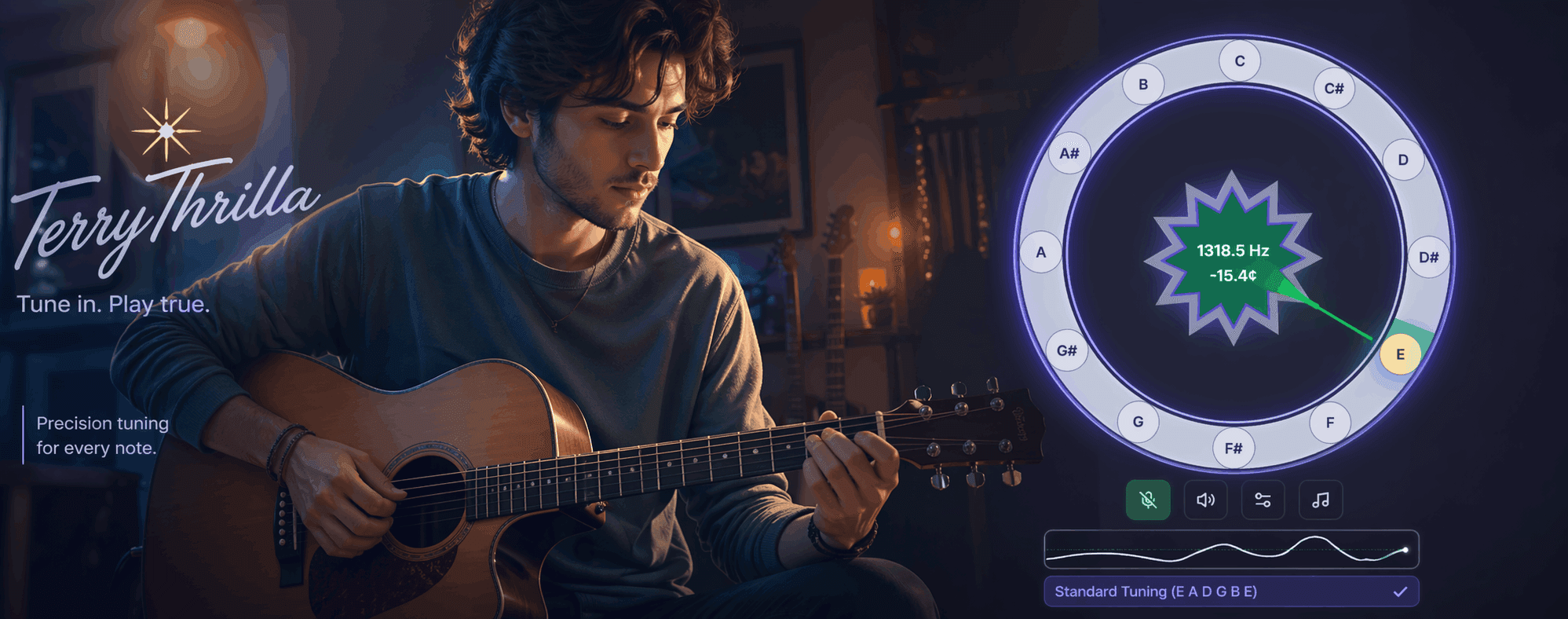
At the center is the Scale Circle: a chromatic wheel of 12 sectors. Play a note and a light beam grows from the center toward its sector. Length shows accuracy, colour shows the zone: green in tune, yellow close, orange off, red far off.
Pick a tuning and string numbers appear as blue badges around the notes that matter. The circle tells you which string to turn, so you can tune your guitar without guessing and without counting frets.
The picture refreshes 60 times per second. A needle teaches you to hit a point; a chromatic tuner built on a circle teaches you to hear musical space.
🟡 Yellow — ±5 cents
🟠 Orange — ±20 cents
🔴 Red — far off
FOR EVERYONE
Three players — one chromatic tuner
For the beginner
Guided Tuning walks you through string by string — six indicators light up one at a time and the tuner names each note for you. Blue badges on the circle show which string is which, so you always know where you are. Tune your guitar without a manual and without second-guessing.
For the self-taught
33+ alternate tunings — Drop D, DADGAD, Open G, Nashville, 7- and 8-string, left-handed. Switching Standard → DADGAD? The circle shows exactly which strings changed. Over 10 instruments, and smart range limiting keeps octaves from being confused.
For the professional
Strobe mode: ±0.1 cents. 13 historical temperaments, each signed with author and year. A-centered mathematics: A=440 Hz always sits at 0 ¢ and every other note deviates relative to it, so the reference A never drifts. Custom A4 from 415 to 466 Hz.
Not only where you are — but where you are going
Full-width pitch history graph
A smooth Catmull-Rom curve over the last 5 seconds. Three colour zones: green (ideal ±3 ¢), yellow (close ±25 ¢), red (far ±50 ¢). Area fill under the curve, an indicator dot with the current value, and a refresh 10 times per second.
Training tool for sound stability
A violinist sees how the hand settles. A saxophonist sees how the breath holds. A guitarist sees how the string drifts after the attack. Most tuners give only a momentary verdict; this graph shows the life of the sound.
HISTORICAL TEMPERAMENTS
13 temperaments. Four centuries. One reference A.
The browser standard offers one temperament — Equal. This tuner offers 13, grouped by era, each signed with author and year. And the key point: all of them are A-centered. A=440 Hz always stands at 0 ¢ and every other note deviates relative to it, so the reference A never drifts.
Equal (12-TET)
The modern standard since the 19th century. All semitones are equal, and every key sounds alike. This is the tuning of practically all contemporary music.
Just & Pythagorean
Pure intonation. Just intonation (Ptolemy, 5-limit) suits a cappella singing and barbershop. Pythagorean tuning suits medieval monody and Gregorian chant.
Meantone — 3 variants
Quarter-comma meantone (Pietro Aaron, 1523 — the age of Monteverdi), plus third-comma and Silbermann’s sixth-comma (German organs of the 18th century). For viols, early keyboards and Renaissance ensembles.
Well-tempered — 6 variants
Werckmeister III (1691), Kirnberger III (1779), Vallotti (1754), Young I (1799), Young II (1802), Kellner (1977). From the young Bach to Schubert and Chopin — four centuries of keyboard tuning in one list.
After tuning — not emptiness
This is what no other guitar tuner gives you. Once the instrument is in tune, you stay on the same circle — the Scale Circle. From there you can see which scales grow out of the note you just tuned, build a chord and hear it, move on to ear training, or open the guitar fretboard and find that note in any position.
The tuner is not the destination. It is the way in to a place where music theory becomes visible.
UNDER THE HOOD
Instrument tuner specifications
YIN algorithm (de Cheveigné & Kawahara, 2002) · Detection range: 50 Hz – 2000 Hz (E1 – B6) · 13 temperaments · 33+ tunings · 10+ instruments · 12 languages · 6 color themes · Chrome 80+ · Firefox 76+ · Safari 14+ · Edge 80+
FAQ
Guitar tuner — frequently asked questions
Tune your guitar — then see what comes next
The tuner sits at the top of this page. When the instrument is in tune, the Harmonization Studio turns your melody into chords — and Partimento explains the model behind it.